Fox Maple School of Traditional Building
Traditional Clay Building Systems Workshop
Corbett, Oregon, July 5-10, 2002
updated June 11, 2002
updated June 11, 2002






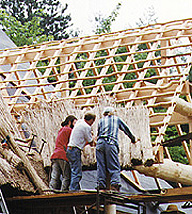
Enclosing a Timber Frame with Natural Clay In-Fill
Corbett, Oregon, July 5-9, 2002
Open House, July 10, 2002
Fox Maple Workshops in natural clay building systems are based on traditional methods, coupled with recent modern innovations and applications currently practiced by professional clay builders in Europe.
The workshop in Corbett, Oregon will cover a variety of
systems and approaches but will have a primary focus on clay/woodchip systems.
This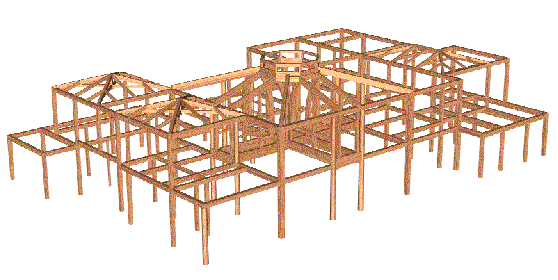 workshop is highly recommended to Architects and Builders who would like
to incorporate these proven techniques into their own projects, as well
as the owner-builder. A strong focus will be set on coordinating efficient
and professional systems and approaches that will allow architects and
builders to readily incorporate clay building systems into their own projects
in a professional manner. The workshop project will focus on methods appropriate
for enclosing a timber frame structure with traditional and alternative
clay systems. The structure will become an Acupuncture and Eastern Medicine
Clinic. Wattle & daub, Straw Clay, Woodchip Clay, Clay Plastering &
Cob building will be covered through hands-on instruction. Corbett, Oregon,
July 5-10, 2002.
workshop is highly recommended to Architects and Builders who would like
to incorporate these proven techniques into their own projects, as well
as the owner-builder. A strong focus will be set on coordinating efficient
and professional systems and approaches that will allow architects and
builders to readily incorporate clay building systems into their own projects
in a professional manner. The workshop project will focus on methods appropriate
for enclosing a timber frame structure with traditional and alternative
clay systems. The structure will become an Acupuncture and Eastern Medicine
Clinic. Wattle & daub, Straw Clay, Woodchip Clay, Clay Plastering &
Cob building will be covered through hands-on instruction. Corbett, Oregon,
July 5-10, 2002.
Tuition and registration options: Full 5 day course,
July 5-9; $600; One Day Design Seminar, July 5th, $150; One day participation,
July 6,7,8 or 9; $125 per day. Open House & Overview, July 10th; $75.
This workshop is co-sponsored by the Northwest EcoBuilders Guild
(NWEBG) and the Timber Framers Guild (TFG). Guild members are eligible
for course discounts. For more registration information and options scroll
down. Registration
Workshop Overview
Clay mixed with cellulose fiber is one of the most ancient
of all building materials. It has been used to enclose timber frame structures
since the inception of timber framing well over 2 thousand years ago. Today,
800 year-old timber frame structures enclosed with clay infill are still
in use throughout northern Europe and Asia. Not a few, but many. The oldest
wood frame structures on the earth all used 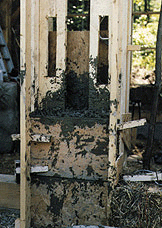 clay
as a wall enclosure system. Is this chance? Or, is there more to it? Are
there lessons to be learned? When we begin to define the term sustainability
as it relates to building, then we must include in the equation the life
span of the structure. As we attempt to develop new building patterns for
this age that take into consideration their impact on the environment in
which we now live in conjunction with their long-term value, then we must
not ignore the empirical evidence that we have before us. Timber frames
with clay enclosures have proven to be the most durable building system
next to stone. In this workshop we will explore the possibilities. A number
of traditional systems will be explored, with a primary focus on those
that can be easily adapted to meet our modern building needs.
clay
as a wall enclosure system. Is this chance? Or, is there more to it? Are
there lessons to be learned? When we begin to define the term sustainability
as it relates to building, then we must include in the equation the life
span of the structure. As we attempt to develop new building patterns for
this age that take into consideration their impact on the environment in
which we now live in conjunction with their long-term value, then we must
not ignore the empirical evidence that we have before us. Timber frames
with clay enclosures have proven to be the most durable building system
next to stone. In this workshop we will explore the possibilities. A number
of traditional systems will be explored, with a primary focus on those
that can be easily adapted to meet our modern building needs.
Clay can be mixed with virtually any cellulose fiber to create a durable building material: straw, woodchips, sawdust, peanut shells, coffee husks, etc. The type of cellulose fiber mixed with clay was traditionally based upon the most common fiber resource available. The resulting clay/fiber mix can be used in a wide variety of ways. It can be formed into bricks, which can be laid to form a solid wall system, or formed into walls directly using slip forms or a light frame and lathing cage. One of the most abundant fibers in the past was straw from grain crops. This was mixed into a relatively dense straw/clay mix and daubed into a wickerwork made up by weaving split willow saplings through oak staves. This system, known as wattle and daub, was one of the most common methods used throughout Europe and Asia for more than a thousand years. For the builder, wattle and daub is one of the easiest and fun ways to build. However, due to the density of the mix it does not provide the insulation value we require to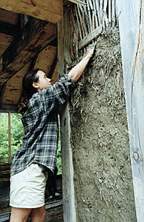 meet modern building requirements in northern climates. Beginning in the early 1970s, a revival of clay building systems took root in Germany, and as a result, many new ways to use the same materials have been studied and developed. These studies have resulted in systems and techniques that have now passed the most stringent building codes in the world and are now in widespread use throughout northern Europe. These have been successful not only because they fulfill the essential need to maintain their traditional use of clay, but also because they are adaptable to nearly any building design or requirement, and perhaps more importantly, by any builder. To make a building system viable on a broader scale, it needs to be easily integrated into the work systems of the common building crew.
The fact is clay remains one of the most viable and sustainable
building materials to this day. While there has been much experimenting
in this country in the past few years, it remains a mystery to most professional
builders and architects. This workshop will focus primarily on how one
can integrate clay building into the mainstream building industry. Ways
into which we can make it a practical option. This will be done by demonstrating
labor and cost efficient methods that can be easily integrated into any
building design by virtually any builder or architect. Clay building should
be a part of every builder and architects vocabulary in this age.
In this workshop we will be demonstrating a number of
traditional clay building systems, but the primary focus will be using
woodchip/clay in-filled into a light framework cage. This system has proven
to be one of the most efficient from a labor standpoint and readily utilizes
an abundant waste product—wood chips—and clay, both of which are generally
free for the taking. In building
with woodchip/clay, material costs are reduced to near zero. This changes
the total economic equation of how we build. This has great economic implications.
By building with the waste products that abound, we now have bypassed the
materials manufacturing industry. The final cost may be equal to any other
system, but, and a large but, the money now expended goes back into the
local community directly as wages. This is an extremely important and principal
aspect of sustainable building. If we are to truly build in a sustainable
way, it must begin by creating a locally sustainable economy. This workshop
will go beyond the nuts and bolts of building to include ways we can harvest
our houses from the environment in which we live.
Day 1) Design Seminar
The first day will begin with a presentation and slide
show discussing a number of traditional clay building systems and appropriate 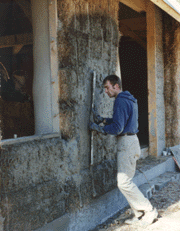 modern
adaptations. There will be ample time for questions and answers. The afternoon
will be filled with hands-on demonstrations of traditional and practical
modern adaptations. This will include mixtures using a variety of fibers
for infill and also earthen plasters. The primary focus will be on identifying
and sourcing materials and how one can set up efficient production systems
that can be readily integrated into any building environment.
modern
adaptations. There will be ample time for questions and answers. The afternoon
will be filled with hands-on demonstrations of traditional and practical
modern adaptations. This will include mixtures using a variety of fibers
for infill and also earthen plasters. The primary focus will be on identifying
and sourcing materials and how one can set up efficient production systems
that can be readily integrated into any building environment.
Day 2-5) Setting up and Working with the Systems
Days 2-5 will be spent setting up the systems, mixing
and preparing the materials, and delivering it into the walls. This will
include an overview of all tools and equipment required. The first step
is to set up and organize an efficient workspace. While there is something
intrinsically fun about working with clay, it can be hard work. Setting
up efficient production systems that carefully analyze inflow and outflow
can save hours and hours of work. While the process of building is and
should be fun, the living in it is the ultimate goal; therefore, setting
up efficient systems becomes one of the most important aspects in making
it practical and cost effective. Students who participate in this process
will leave understanding the full nature of how one can build with the
stuff beneath your feet.
Day 6) Open House
The morning will begin with a presentation and overview
of clay building systems in general, and specifics on the system used on
the project. There will be ample time to get muddy for those inclined.
This is a great opportunity for anyone interested in incorporating clay
building into their building future--contractors, architects, professional
builders, and owner builders, to see and to feel and to taste clay building
first hand.
Tuition
Full Workshop: July 5-9, $600
Participants in the full workshop will receive breakfast
and lunch, a workshop specific T-Shirt, and copies of
A Timber Framer's Workshop and The Alternative Building
Sourcebook.
One day Design Seminar: July 5, $150 Registration
Form
Includes breakfast and lunch, T-Shirt and a copy of the
Alternative
Building Sourcebook
One day participation: July 6,7,8,9; $125 per day Registration
Form
Those unable to attend the full workshop can register
for one or more days.
Includes breakfast and lunch, T-Shirt and a copy of the
Alternative
Building Sourcebook
Open House: July 10; $75 Registration
Form
This is a great opportunity for builders, architects
and owner-builders to see how clay building systems work.
Includes breakfast and lunch, T-Shirt and a copy of the
Alternative
Building Sourcebook
Discounts, Scholarships and Work-Trade Possibilities
Registration
You can register directly on-line, fax or via mail. Registration
requires a 50% deposit. When registering on-line you will be charged 50%
of the stated tuition. The balance will be due upon checking in at the
workshop. Any association discounts will be credited at that time. To register
by fax or mail, go to the Registration
Form, print it out and fax or mail it to FMSTB (address below). All
pertinent information is included on the form. When paying by check or
MO, include 50% of the tuition amount and make checks payable to Fox Maple
School of Traditional Building. A complete workshop confirmation packet
(including books) will be sent upon registration. T-shirts will be handed
out at the workshop. Please include size when registering.
Lodging and Camping
Camping will be available on-site and a list of local
motel and B&B options will be sent to all registrants.
Fox Maple School of Traditional Building
PO Box 249
65 Corn Hill Rd.
Brownfield, ME 04010
207-935-3720
www.foxmaple.com
To register for this event click here Registration Form
For local information contact:
Katy Langstaff, M.Arch.
SUSTAINABLE SYSTEMS DESIGN
2047 N.E. Davis Street
Portland, Oregon 97232
(503) 230-7772
wildgoose@sustainablesystems.org
This workshop is co-sponsored by the
Timber Framers Guild
and
The Northwest
EcoBuilding Guild

NWEBG Website Link
TFG Website Link
One of the oldest traditional forms of enclosure, often seen in historic European half timbered buildings, Wattle & Daub can last for centuries. The work group will prepare and install the wattles, using materials harvested from the local woods, mix, and apply the straw/clay daub. Wattle & Daub may not be the best system for enclosing exterior walls in northern climates due to the density of the mixture of clay, but it may well be the most interesting and fun clay based building system of all. Understanding its properties will open up new doorways into building with natural materials. Wattle & Daub
An adaptation of a centuries-old wall system, Wattle & Daub, straw light clay uses the same materials but is fashioned in a way that provides greater insulating qualities. The straw, mixed with clay slip, can be installed using a slip form system, or in a cage built from light framing (2x2s) and lath or reed matting. The advantage of straw light clay in modern building is that the thickness of the wall can be increased to provide greater insulating value as dictated by the local climate. It also uses materials which can be obtained locally, requiring only body energy as opposed to embodied energy. Straw/Light Clay & Woodchip/Light Clay
Wood chips can also be mixed with a clay slip to create a wall infill that has efficient insulating and fire resistant properties similar to straw clay. The advantage is in the labor to produce the mixture and to infill in the walls, which is about half that of straw clay. In wood producing regions, wood chips become an attractive option.
In addition to traditional clay infill systems, we will be using a variety of more modern systems that use materials appropriate to the region in which a building is constructed, and with labor-saving innovations. A variety of systems including unfired straw/clay blocks, reed matting, wood chips and cellulose fibers will be demonstrated and used. Alternative Infill Systems
Clay plastering provides a natural, durable and breathable wall finish with low embodied energy. This workshop covers the system from A to Z from preparation to application for a number specific building applications; straw bale, reed matting, wood lath, woodchip/clay and Cob, interior and exterior use. Clay Plastering
What's Included, What's Not
All Fox Maple workshops include light breakfast and a hearty lunch, a workshop specific Fox Maple T-shirt, and a copy of A Timber Framer's Workshop by Steve Chappell and/or The Alternative Building Sourcebook, depending on the course. Camping is available on the grounds, and equipped campgrounds are close by. Local Bed and Breakfasts offer special rates to all students (about $30 per night). A wide choice of restaurants and motels are within 10 miles. Complete info will be included in all confirmation packets sent to workshop registrants. Traveling workshops include the basic meal / T-shirt / Book package, and lodging info will be available upon registration. return to list
Home Page / News and Information / The Current Issue of JQ / The Alternative Building Source Book / JQ Merchandise /
Workshop Registration Form / Timber Framing WorkshopsGet on our Mailing list: Email us for Newsletter and Workshop Updates or Questions
(include mailing address)All contents Copyright by Fox Maple Press, Inc. All rights reserved.